Your Virtual Assistant is Outdated: Why Smart Businesses Are Switching to AI Agents in 2026
The post breaks down exactly why the VA model has a structural ceiling for service businesses, what AI agents actually do differently (autonomy, multi-step action, 24/7 coverage), which tasks they are taking over first (lead response, qualification, booking, follow-up, onboarding), the real cost com
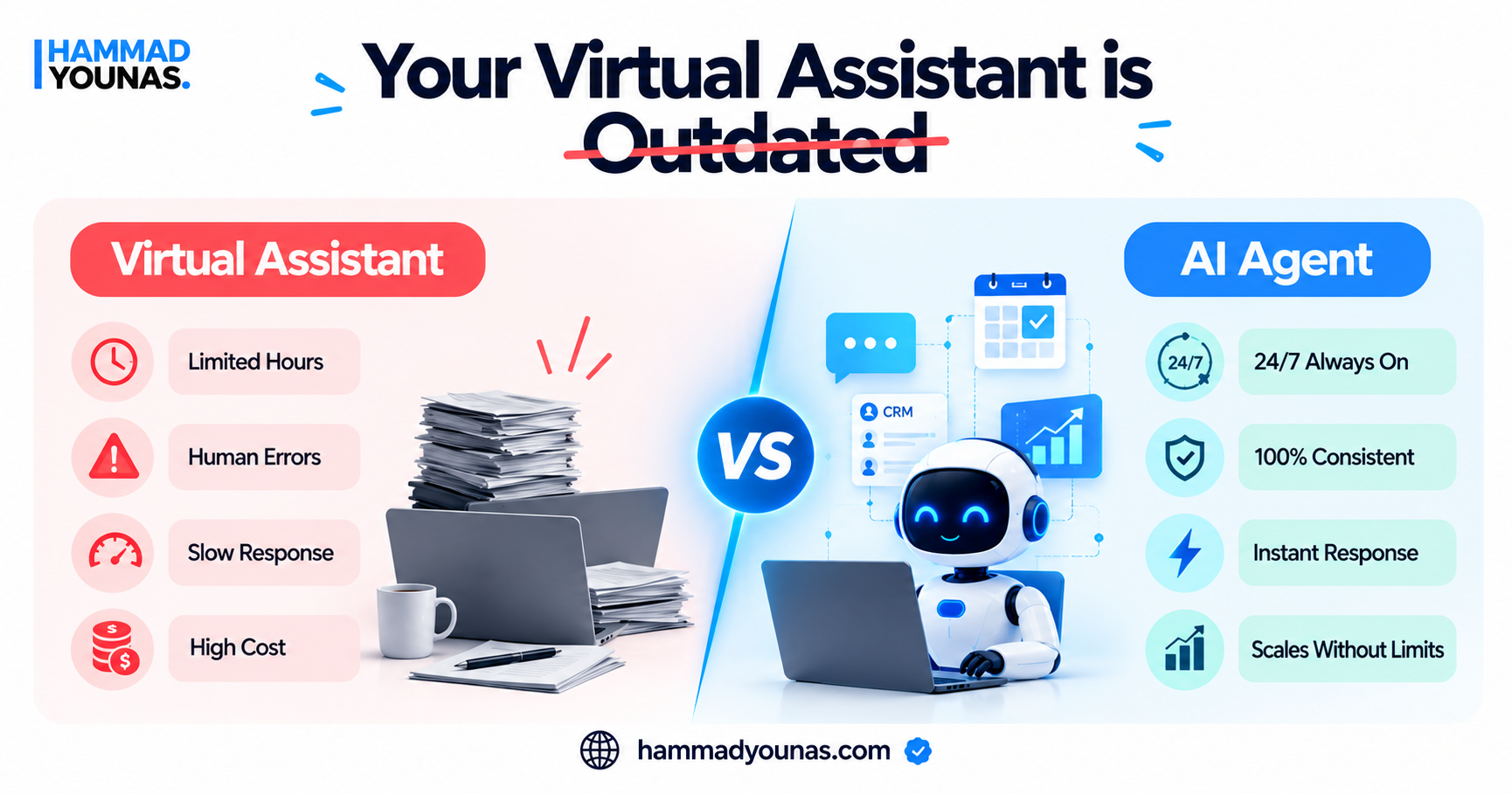
Hiring a virtual assistant made a lot of sense a few years back. You had someone managing emails, booking appointments, following up on leads, keeping the daily admin from piling up. For many business owners, it was enough to stay on top of things.
But "enough" does not cut it anymore. The businesses moving ahead right now are not hiring sharper VAs. They are replacing manual hand-holding with AI agents that work faster, operate around the clock, and never need day-to-day babysitting. That gap between the two models is growing every single month, and the businesses still relying on a VA for repetitive, high-volume work are starting to feel the cost of it.
This is not a story about replacing people to save money. It is about recognizing what the work actually demands and whether the tools you are using are still the right fit.
What a Virtual Assistant Actually Does (and Where the Model Falls Apart)
A traditional VA, whether local or offshore, runs on instructions. You tell them what needs doing, they handle it during their hours, and when their day ends, so does the coverage. Quality depends on the individual, how clearly the brief was written, and whether that Tuesday follow-up made it onto their task list.
The problems with the model are not about the people. They are baked into the structure:
Coverage gaps: A VA works a shift. Leads that land at 9pm on a Friday sit untouched until Monday. In service industries, that kind of wait usually means a lost deal.
Consistency problems: Even a reliable VA will phrase things differently each time, skip a step on a busy day, or forget a follow-up buried in a backlog. Consistency at real scale requires a system, not a person.
Single-point dependency: Everything flows through one human. When volume picks up, quality slips. When your VA gets sick or moves on, the entire process stalls until someone new is trained.
Divided attention: A VA handling inbox, calendar, lead follow-up, and admin tasks all at once is not giving proper focus to any of them. The highest-priority work ends up competing with everything else on the list.
None of this makes VAs worthless. It just means there is a ceiling on what the model can deliver, and growing businesses tend to hit that ceiling faster than expected.
What an AI Agent Actually Does Differently
An AI agent is not a more sophisticated chatbot. It is a system that watches for triggers, makes decisions based on defined logic, and takes action across multiple tools without waiting to be told each time.
A new lead fills out a form at 11pm. The AI agent fires back within seconds, opens a qualifying conversation, checks what is open on the calendar, books the call, and logs everything in the CRM. By the time anyone on the team sees the notification the next morning, the lead is already scheduled and in the pipeline.
That is the real difference. A VA executes tasks. An AI agent runs a process. That distinction matters enormously when the volume is high and the stakes are real.
Properly built AI automation systems handle the full lead journey inside one platform: first contact, qualification, booking, multi-step follow-up, onboarding triggers, and review requests. Each step flows into the next on its own, with no one managing the handoffs between them.
And unlike a VA, an AI agent does not slow down when the volume triples. Ten leads or a thousand, the response is the same speed and the same quality.
The Specific Work AI Agents Are Taking Over
It helps to be concrete about where AI agents are replacing the VA model. These are the areas where the switch is already happening:
Lead response: Being the first to reach out after a form submission dramatically improves conversion rates. An AI agent fires back within seconds, any hour of the day. No VA matches that coverage, and the difference in outcome is measurable.
Qualifying conversations: Agents trained on your offer, your ideal client profile, and your common objections can carry a full qualification conversation over SMS or email. By the end, they know whether to book the lead or route them to a nurture sequence.
Appointment scheduling: Real-time availability checks, booking confirmations, reminder sequences, rescheduling flows, all handled without anyone touching the calendar. Doing this through a VA means someone has to monitor it constantly to catch conflicts and missed reminders.
Follow-up sequences: Most leads do not say yes on the first contact. AI agents run follow-up across multiple channels over days or weeks, adjusting based on what the contact does or does not respond to. A VA managing two hundred leads in follow-up manually will drop things.
Client onboarding: When a deal closes, the AI agent triggers the entire onboarding flow: welcome messages, intake forms, document requests, internal task assignments. It runs the same way every time regardless of how stretched the team is.
The outreach automation built for a real estate client captures what this looks like in practice. Response times dropped from hours to under sixty seconds, and the process ran without daily management from anyone on the team.
The Real Cost Comparison
This is where the math surprises most people. A capable VA in a useful timezone runs anywhere from $800 to $2,500 per month, depending on skills and hours. That covers one person, working one shift, handling whatever volume fits in their day.
An AI agent system built on GoHighLevel typically runs $300 to $600 per month in platform costs, plus a one-time investment to build and configure it properly. It operates 24 hours a day, handles unlimited volume, and performs identically at 3am as it does on a Tuesday afternoon.
For businesses with consistent lead flow and repeating processes, the cost-per-outcome comparison is not close. The voice qualifier deployed for a coaching client made this concrete: 70% of the time previously spent on pre-qualification calls came back to the team, with no drop in the quality of leads reaching the sales stage.
The question is not whether AI agents are cheaper. For most service businesses, they are. The question is whether your processes are defined clearly enough to hand off to a system. For most, they are.
Where VAs Still Make Sense
Being honest about this matters. AI agents are not the right fit for everything, and the goal is not to automate every task in sight.
Virtual assistants still add real value where the work demands judgment that cannot be scripted, emotional nuance, or creative problem-solving with high variability. Complex client relationships, sensitive conversations, high-stakes negotiations, and genuinely unpredictable situations are still better handled by a real person who can read the room.
The more useful framing is not VA versus AI agent. It is: which parts of your workflow are repetitive and high-volume enough to hand off to a system, and which parts genuinely need human judgment?
For most service businesses, 60 to 80 percent of what moves through a VA today falls cleanly into the first category. That does not eliminate the need for people. It changes what people spend their time on.
How to Make the Transition Without Losing What Works
The most common mistake businesses make when moving to AI agents is trying to build ten workflows at once. The result is usually ten half-finished things and a team that does not trust any of them.
The better approach is to start with the single workflow that has the most volume, the clearest steps, and the most to gain from consistency. For most service businesses, that is lead response and booking. Build that one properly, watch it closely for the first four weeks, adjust based on what the conversation data shows, then move to the next.
Platform matters here too. GoHighLevel remains the most complete option for service businesses because the CRM, AI conversation layer, calendar booking, pipeline management, and two-way messaging all live in the same environment. No duct-taping separate tools together, no data falling through gaps between platforms.
If you want to know what this would look like for your specific setup, a free audit maps the current gaps in your lead and client process and shows exactly where an AI agent system would make the difference. No sales pitch, just a clear picture of where you stand.
The Bigger Picture
Virtual assistants were the right tool for a specific moment. They helped businesses scale past what the owner could handle alone, without the cost and complexity of building a full team. That was genuinely useful, and it still is for the right kind of work.
But the tools available now have moved past what the VA model can compete with on high-volume, repeating work. Businesses that recognize this shift early are not just trimming overhead. They are building systems that compound over time: faster response, more consistent process, and the same team handling significantly more volume month after month.
The businesses still running manual workflows through a VA are competing on a different playing field. That gap does not close on its own.
If you want a clear picture of what switching to an AI-driven system would actually involve for your business, the free 30-minute audit is the fastest way to find out. Walk in with your current setup, walk out with a concrete plan.